
19th century corals unlock a new understanding of ocean acidification in the California Current and Salish Sea
By Joe Selmont, CICOES
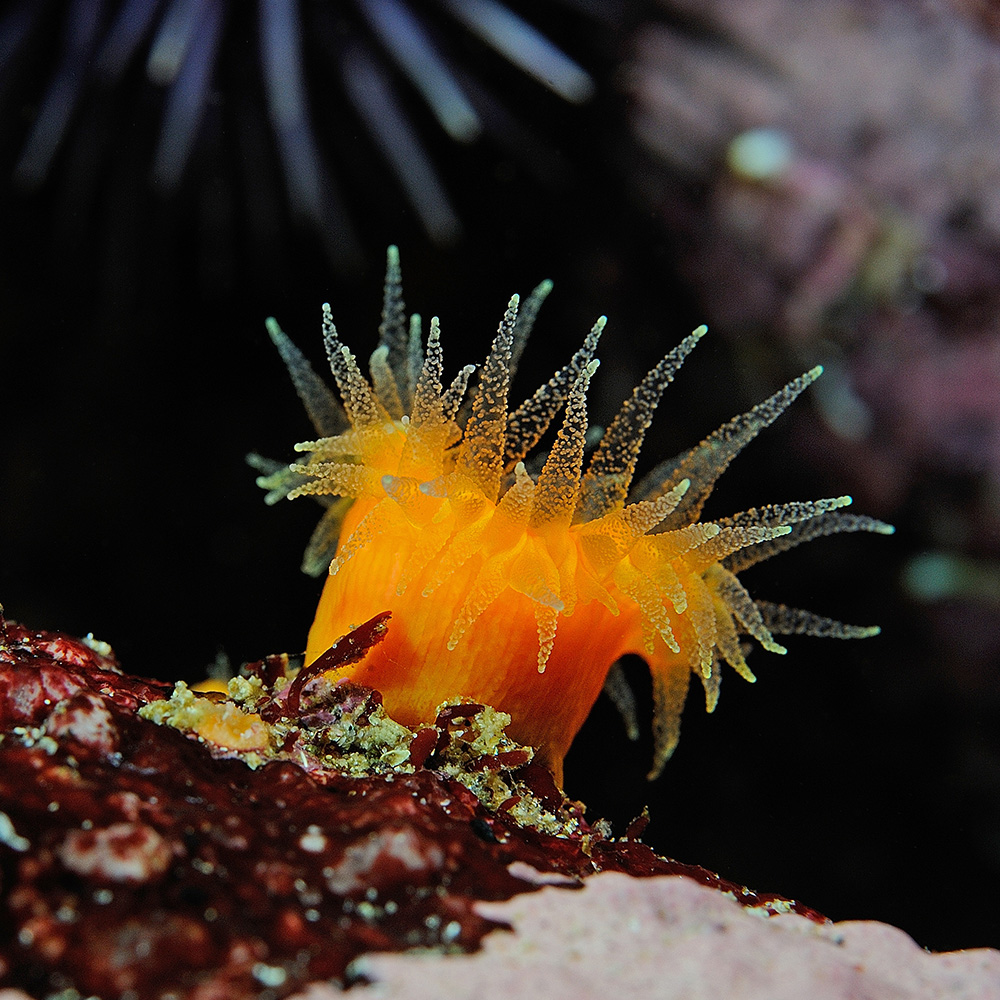
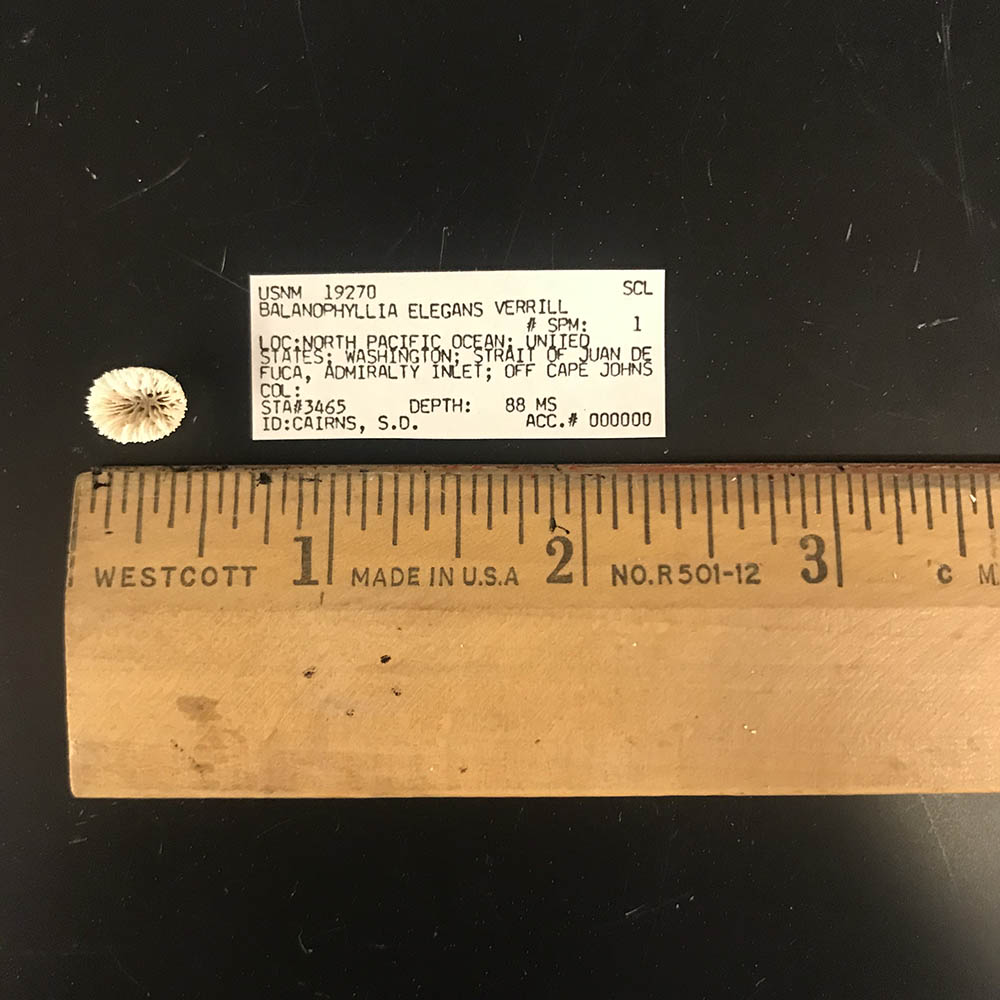
For more than a century, a collection of orange cup coral skeletons bided their time in the Smithsonian’s archives. The corals were acquired off the U.S. West Coast by the crew aboard the R/V Albatross, a steam-powered, cast iron vessel and the first ship built specifically for marine research by any government. The crew meticulously categorized, preserved, and transported the specimens back to Washington, D.C., where the Smithsonian’s staff carefully stored them for future generations of researchers.
Now, those orange cup corals provide key insights in a new study by University of Washington (UW) and National Oceanic and Atmospheric Administration (NOAA) scientists about ocean acidification — the chemical process by which carbon dioxide from the atmosphere enters seawater and decreases the pH level. Published in Nature Communications, the study determined that the California Current and Salish Sea have acidified more rapidly than global oceans from the pre-industrial era to the present day.
This rapid acidification is troubling in part because, due to quirks of geography, many West Coast waters are more naturally acidified than the open ocean. Acidifying waters can harm economically and culturally important species such as oysters and Dungeness crab.
The UW and NOAA researchers combined laboratory analysis of historic and modern samples of Balanophyllia elegans, the scientific name of the orange cup coral, with regional ocean models — which are a set of computer simulations that use real-world observations and scientific principles to recreate physical and chemical conditions at specific locations through the past, present, and future.
“Corals are like little time capsules,” said Mary Margaret Stoll, a recent PhD graduate of the UW School of Oceanography and the study’s lead author. “They build skeletons that record the chemistry of the seawater they live in.”
Cracking open those time capsules, however, was no easy task.
The hunt for orange cup corals
First, Stoll had to track down the historic specimens from museums around the country to supplement the Smithsonian’s orange cup coral collection. She spent weeks in the spring of 2020, during the early days of the COVID-19 pandemic, hunkered down in her apartment scanning through records and playing phone-tag with museum archivists, only to encounter a great many dead-ends.
It turned out that not every coral collector retained the same level of detail as the crew of the Albatross. Stoll explained that exact date, location, and depth of collection were essential prerequisites for a sample to be included in the study.
But her persistence paid off: Stoll eventually obtained 54 coral samples collected between 1888 and 1932.
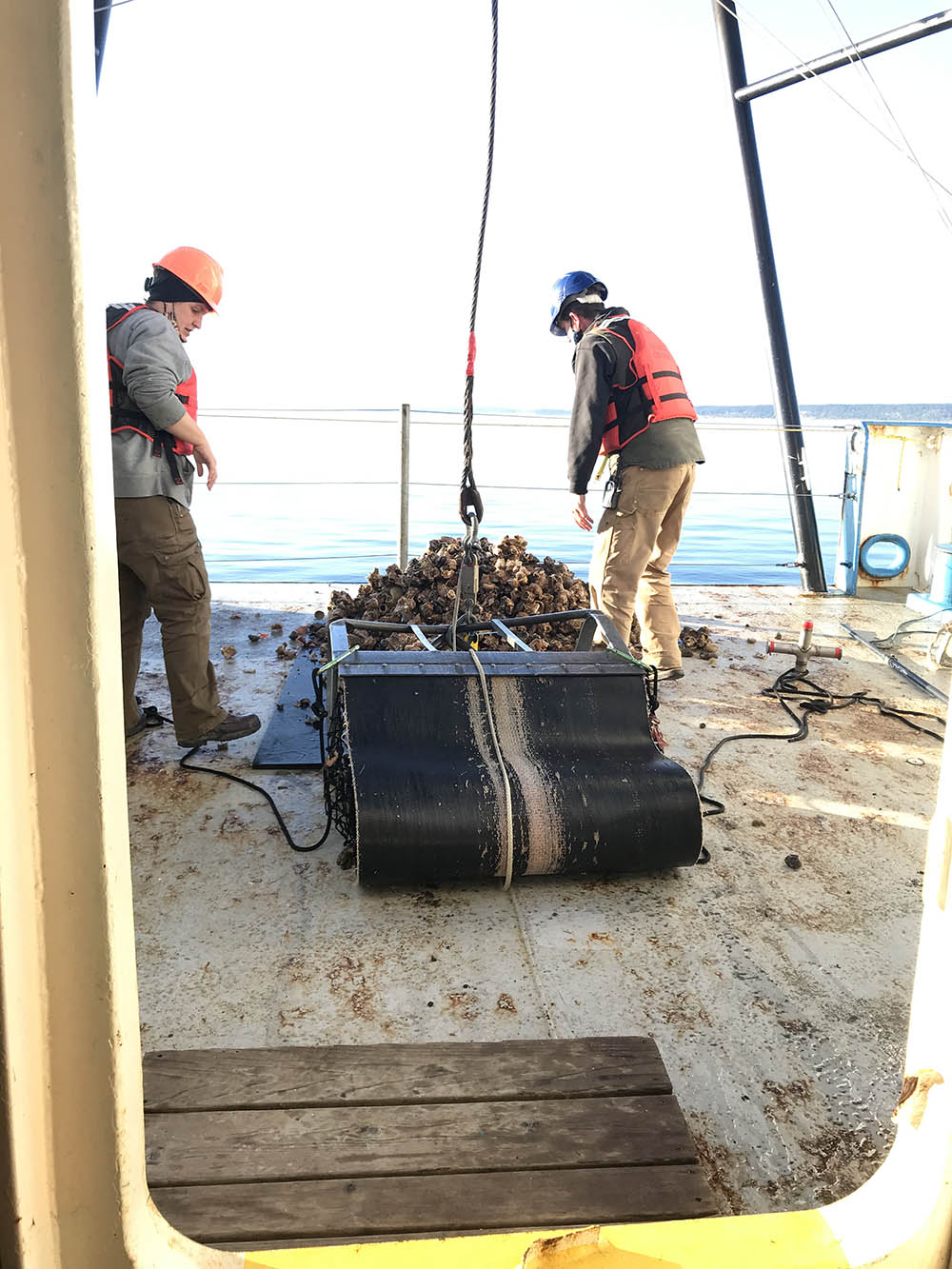
Stoll and her collaborators then went about collecting modern samples under the waves of the Salish Sea. In the fall of 2020, they boarded the R/V Rachel Carson, a UW-operated research vessel, and sailed to the same latitudes and longitudes, then dredged at the same depths, where the historic samples were collected.
This exactness was necessary to avoid an apples-to-orange-cups comparison. If, for example, they compared an orange cup coral that grew 10 meters below the surface to one that grew another 10 or 20 meters deeper, it might be possible to attribute chemical differences to this discrepancy, rather than a changing environment.
“I knew my first time at sea would be an adventure,” said Stoll, “but the COVID pandemic added a layer of unpredictability that made it even more memorable.”
From testing and quarantine logistics to a pared-down crew, Stoll explained that every step of the cruise took extra coordination. But it also made moments like spotting that first orange cup coral especially triumphant and rewarding.
Ultimately, the research team came ashore with plenty of coral samples in hand. At this point, Stoll and her colleagues moved into the laboratory.
Measuring “chemical fingerprints”
Orange cup corals do not exist in a vacuum, but in a dynamic environment surrounded by seawater. As the corals grow, their skeletons make a record of that seawater: their chemical composition will vary subtly depending on latent conditions.
For example, corals take up boron as they grow, and the mix of boron isotopes they incorporate reflects the pH level of the surrounding seawater. When the ocean becomes more acidified, corals record lower levels of a heavy isotope called boron-11.
“It’s like a chemical fingerprint,” said Stoll. “And we use boron isotope analysis as a way to identify that fingerprint.”
Stoll and her collaborators placed microscopic slivers of each coral skeleton into a mass spectrometer, a highly sensitive piece of laboratory equipment that is capable of distinguishing even miniscule shifts in chemical composition with extraordinary precision.
The mass spectrometer works by turning a sample into charged particles, or ions, and then sending them through an electric or magnetic field. Because lighter particles bend more and heavier ones bend less, the instrument can separate them by mass. A detector then counts how many of each type are present.
Light particles in one bucket. Heavy particles in another.
The method of using boron isotope analysis in this specific species of coral to reconstruct ocean conditions was first developed by UW oceanographer Alex Gagnon and Anne Gothmann, a former postdoctoral scholar with the UW Cooperative Institute for Climate, Ocean, and Ecosystem Studies (CICOES). Gagnon, an associate professor with the School of Oceanography, also serves as the principal investigator for the broader research project that produced this new study.
“We cultured orange cup corals in the lab in a wide variety of environmental conditions,” said Gagnon. “Then we developed a calibration to link the chemical signatures in the coral skeletons to the seawater conditions in which they grew.”
Gagnon and Gothmann grew the corals under tightly controlled conditions, adjusting the pH level and other chemical properties in different tanks. This experimental setup enabled them to extensively test how the corals’ boron isotopic composition responded to changes in pH. After completing the experiment, they knew the precise relationship between acidity and the boron isotopic composition in the coral skeletons.
They knew the exact shape of those specific “chemical fingerprints.”
As Stoll and her collaborators worked through the coral samples using Gagnon’s and Gothmann’s boron isotope method, they found that the modern samples had substantially less boron-11 than the historic samples. This meant that, as expected, the West Coast waters had acidified over the industrial era.
In fact, they had uncovered evidence that the California Current and Salish Sea were acidifying even faster than the global ocean, an effect known as amplification — which came as a bit of a surprise.
“Going into this research project, there were good arguments in the literature that certain processes might lead to a dampening effect and others might lead to an amplifying effect,” said Gagnon. “Unfortunately, our research shows quite clearly that there is an amplifying effect, which is bad news for these ecosystems.”
The boron isotope analysis provided a clear line of evidence about what changed over the industrial era, but understanding the underlying mechanisms would require another line of investigation.
Traveling backward and forward in time
The researchers needed to test whether chemical and physical processes could account for the patterns preserved in the coral skeletons.
So, at this point, they turned to regional ocean models — computer simulations that recreate how water moves and changes. Unlike global ocean models, which focus on the planet as a whole, regional models zoom in on a smaller area. They incorporate real-world data, such as temperature, salinity, and currents, alongside equations that describe how seawater behaves.
The result is a high-resolution “digital ocean” that scientists can rewind or fast-forward through time.
“Global models are too coarse to capture the Salish Sea and California Current in detail,” said Hartmut Frenzel, a research scientist with CICOES who co-authored the study. “That’s where regional models come in. They let us simulate the physical and chemical conditions of a specific area of the coast with much higher accuracy.”
The team simulated ocean conditions along the West Coast for the late 1800s and the present day. They fed the model with information from the coral analysis, calibrating it to acidity conditions in the late 19th and early 20th centuries.
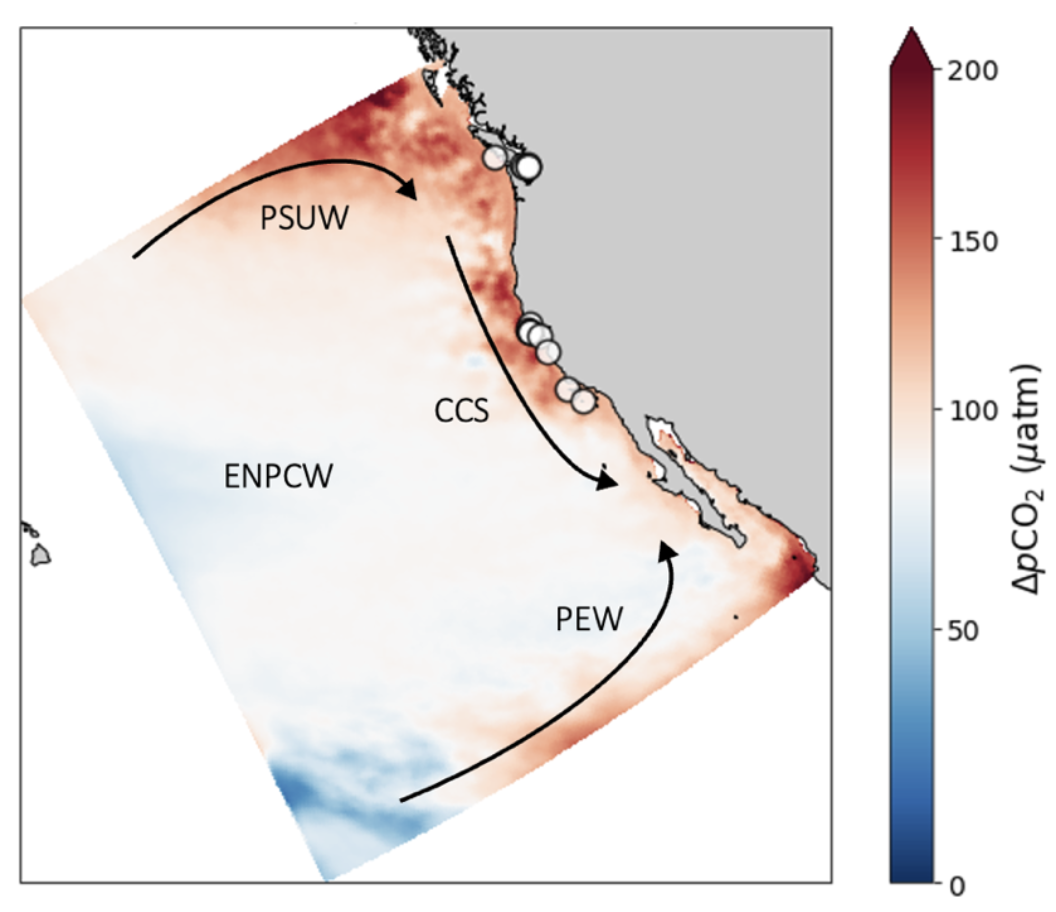
“We’ve been running regional models for 20 years,” Frenzel said, “but this was the farthest back we’ve ever taken one in time. We don’t have pH values from 1890, so that’s where the corals came in. They gave us a way to check whether the model was getting it right.”
The simulations supported the conclusion that the patterns seen in the coral skeletons weren’t random; they reflected that ocean acidification in coastal waters was being amplified. The models showed that carbon-rich water rising from the deep ocean through a natural process called coastal upwelling was compounding the effect of atmospheric carbon dioxide interacting with seawater. Upwelling also serves to bring nutrients from the ocean’s depths into coastal waters — a key contributor to the biological abundance and diversity of coastal ecosystems.
The team also incorporated ocean acidification measurements made by the Washington Ocean Acidification Center (WOAC) and NOAA on seasonal cruises to measure modern conditions in the Salish Sea. Along with the coral results, those observations helped the model stay grounded in real-world data.
“We have only monitored changing acidification conditions and ecosystem impacts in the Salish Sea since 2008, so it’s exciting that WOAC cruise data could also help unlock information stored in historical time capsules like these orange cup corals,” said Simone Alin, who is a supervisory oceanographer at NOAA’s Pacific Marine Environmental Laboratory, as well as a founding research partner at WOAC and a co-author of the study.
The regional model’s century-spanning “replay” of the California Current and Salish Sea confirmed that localized acidification is not only keeping pace with global oceans — it is exceeding that pace as a direct consequence of how physics, chemistry, and human activity intertwine along the West Coast.
What comes next?
The combination of century-old coral skeletons and modern computer simulations paints a picture of an ocean that is changing faster, and more deeply, than scientists once believed. The very processes that make the California Current and Salish Sea so biologically rich are now amplifying the effects of human-driven carbon emissions.
“The upwelled waters we see today started their journey to the surface decades ago, when the ocean was less acidified,” said Gagnon. “As we move forward, the waters rising to the surface will already be more acidified when they begin that journey. That means the baseline is shifting, and it’s shifting in a dangerous direction.”
That shift could have cascading consequences for marine ecosystems and the communities that depend on them. More acidified waters make it harder for shell-building species, such as oysters, crabs, and certain plankton, to form and maintain their skeletons. Those species, in turn, are vital food sources for salmon, seabirds, and other marine life.
As ocean chemistry continues to change, entire food webs could be reshaped from the microscopic level up.
But Stoll and Gagnon see opportunity in understanding the problem more clearly. By uncovering how and why acidification is amplified in the California Current and Salish Sea, scientists can better predict where and when the impacts will be most severe. They say that the future is under our control. If we choose to make steep CO₂ emission reductions augmented by new technologies like carbon removal, then we can avoid the worst impacts of ocean acidification.
“It’s amazing to think that corals collected more than a century ago can tell us so much about how our oceans are changing today,” Stoll said. “But these changes are happening in an incredibly productive and culturally important region. Understanding them is essential if we’re going to adapt to what comes next.”
—
The study “A century of change in the California Current: upwelling system amplifies acidification” in Nature Communications was authored by Mary Margaret Stoll (UW School of Oceanography), Curtis A. Deutsch (Princeton), Hana Jurikova (University of Saint Andrews), James W.B. Rae (University of St. Andrews), Hartmut Frenzel (UW CICOES), Anne Gothmann (St. Olaf College), Simone R. Alin (NOAA PMEL), and Alex Gagnon (UW School of Oceanography).